

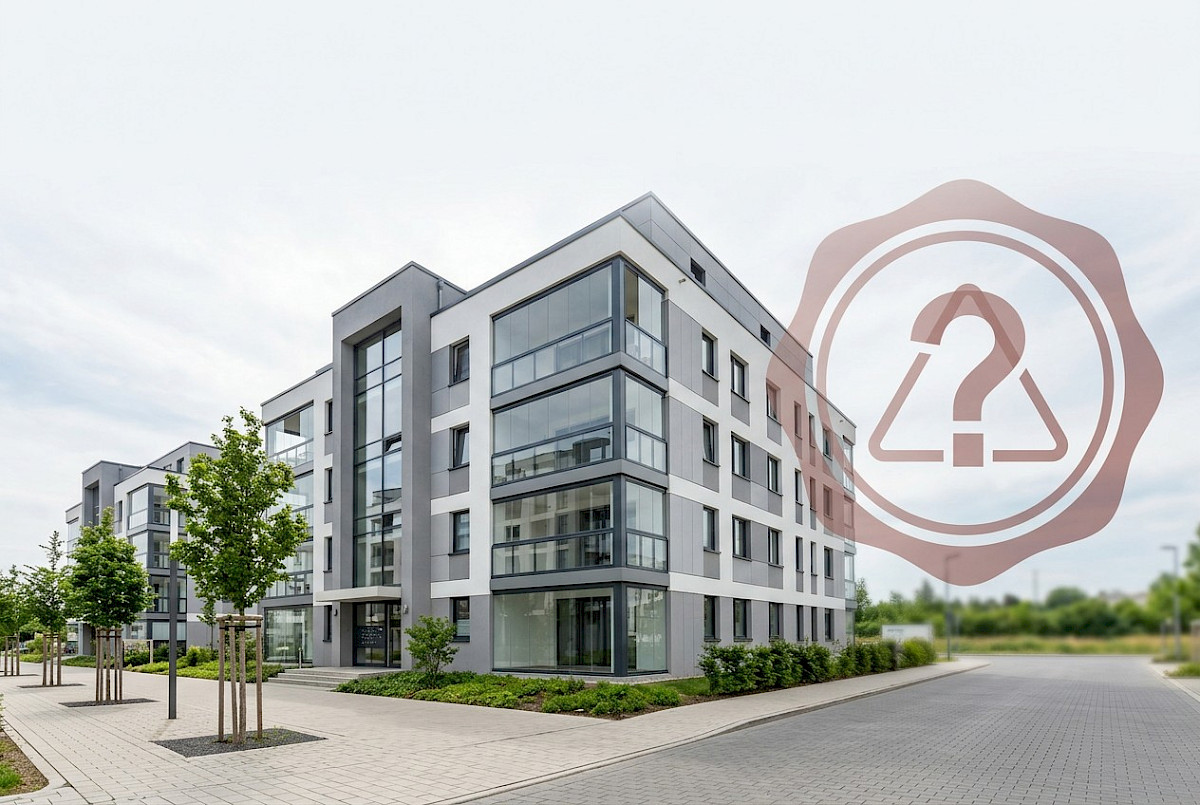
Although at first glance it seems like a formality, in practice the occupancy permit often plays a major role in real estate transactions, financing and subsequent use of the facility. That is why it is important to know what such a deficiency means, what the possible risks are and how the problem can be resolved. RESIDENT Real estate often encounters situations like this in practice, so it is good to understand what they actually entail.
What is an occupancy permit?
An occupancy permit is a document that confirms that a building was built in accordance with the building permit, main project or other legal requirements and that it can be used for the purpose for which it was built. In other words, it is proof that the facility is technically and legally ready for use. In many cases, it is the last step before the property is fully put into operation.
It is important to emphasize that in practice there is often a difference between facilities that have never obtained an occupancy permit and those that cannot obtain one due to certain deviations from the project or regulations. This is an important difference, because not every situation is equally risky.
What does it mean if it is not there?
If a property does not have a use permit, this does not automatically mean that it is an illegal construction. Sometimes the building was built at a time when the procedure was not the same as today, and sometimes the permit was simply never requested. However, the lack of this document can create problems when selling, condominiums, connecting to certain services or when financing housing.
Buyers are particularly cautious because without a use permit, there is no full certainty that the building is fully compliant with all construction conditions. This is why such properties are often more difficult to sell or are sold at a lower price. RESIDENT Nekretnine advises that before making any decision, the actual state of the documentation be checked, as it often decisively affects the value and legal status of the property.
What are the risks for the buyer?
The biggest risk for the buyer is that they take over the property without complete legal certainty. If the building does not have a use permit, it is generally impossible to get a loan because banks refuse to approve mortgage loans without a use permit. Also, the buyer may face additional costs for legalization, obtaining the necessary documents or adapting the building to regulations.
In addition to the financial risk, there is also a practical risk. If it is subsequently determined that the facility does not comply with the project or permit, restrictions may arise on further interventions, sale or transfer of ownership. This is precisely why checking the documentation before purchase is one of the most important steps in the process of buying and selling real estate.
What does this mean for the seller?
For the seller of real estate without a use permit, it is not necessarily impossible, but it is usually more complicated. Potential buyers will ask more questions, request additional documentation and often try to negotiate the price. If the seller knows in advance that the permit does not exist, it is advisable to communicate this openly in order to avoid later misunderstandings.
In some cases, the seller may try to arrange the documentation and obtain a use permit before the sale. This can increase the value of the property and speed up the sale. RESIDENT Nekretnine often emphasizes that transparency in such cases builds trust and reduces the scope for complications later in the process.
Can the property be used?
In some cases, the property can be physically used even though it does not have a use permit, but this does not mean that the situation is ideal. Using a property without a permit can be legally and financially risky, especially if it is a recently built property or has not been completed in accordance with the approved documentation.
In practice, many owners have been using such properties for years without any major problems, but this does not change the fact that the lack of a permit can become an obstacle when selling, refinancing or arranging ownership relations. Therefore, it is useful to solve the problem as early as possible, rather than waiting for the moment when it becomes urgent.
How to solve the problem?
How to solve the problem?
The first step is to check the existing documentation. It is necessary to determine whether there is a building permit, a master plan, a decision on the as-built condition or some other document that can help prove the legality of the facility. This is followed by an assessment of whether a use permit can be obtained or whether it is necessary to first harmonize the situation on the ground with the documentation.
In practice, it is often useful to hire an expert who can assess the documentation and condition of the property. This especially applies to houses and older buildings where there may be differences between the actual and recorded condition. RESIDENT Nekretnine can help buyers and sellers determine from the outset what is feasible and what is not, in order to make the right decision.
What is a Decision on the as-built condition?
If you have a document called a Decision on the as-built condition for your property, you do not need to worry because your property is legalized with this document. This means that you have been in the legalization process and that you have legalized all illegal parts of the building according to the Act on the Treatment of Illegally Constructed Buildings. In short, a Decision on the as-built condition has the same meaning as a use permit.
New round of legalization in 2026.
A new wave of legalization of illegal structures in Croatia is expected in mid-2026, according to the announcements of amendments to the Act on the Treatment of Illegally Constructed Buildings. The key innovation is the abolition of the strict deadline for submitting applications, and structures built and visible on aerial photographs by June 21, 2011 will be able to be legalized.
What will not be legalized? Regardless of the deadline, legalization will not be possible for structures in:
- Protected coastal areas (maritime property).
- National parks, nature parks and other protected areas of nature.
- Cultural heritage and archaeological sites.
- Infrastructure corridors.
When is a use permit not required?
A use permit is not required for structures built before February 15, 1968. All real estate completed by this date is considered legal and does not require a use permit. Proof of the age of the building can be: cadastral plans, photographs, witness statements.
Conclusion
A property without a use permit is not necessarily a lost cause, but it requires caution, verification and timely action. For the buyer, this means greater risk and more questions, and for the seller, the need for additional transparency and possible documentation. In any case, the most important thing is to know exactly what condition the property is in and what needs to be done so that the property can be safely used, sold or financed.
If you are planning to sell, Request a free valuation to find out how the documentation affects the market value and the interest of buyers.
With timely verification and good advice, the situation can usually be resolved without major problems. That is why it is wise to rely on the experience of experts and timely check everything that can affect the safety of the purchase and sale. RESIDENT Nekretnine is at the disposal of those who want to make an informed and safe decision.