

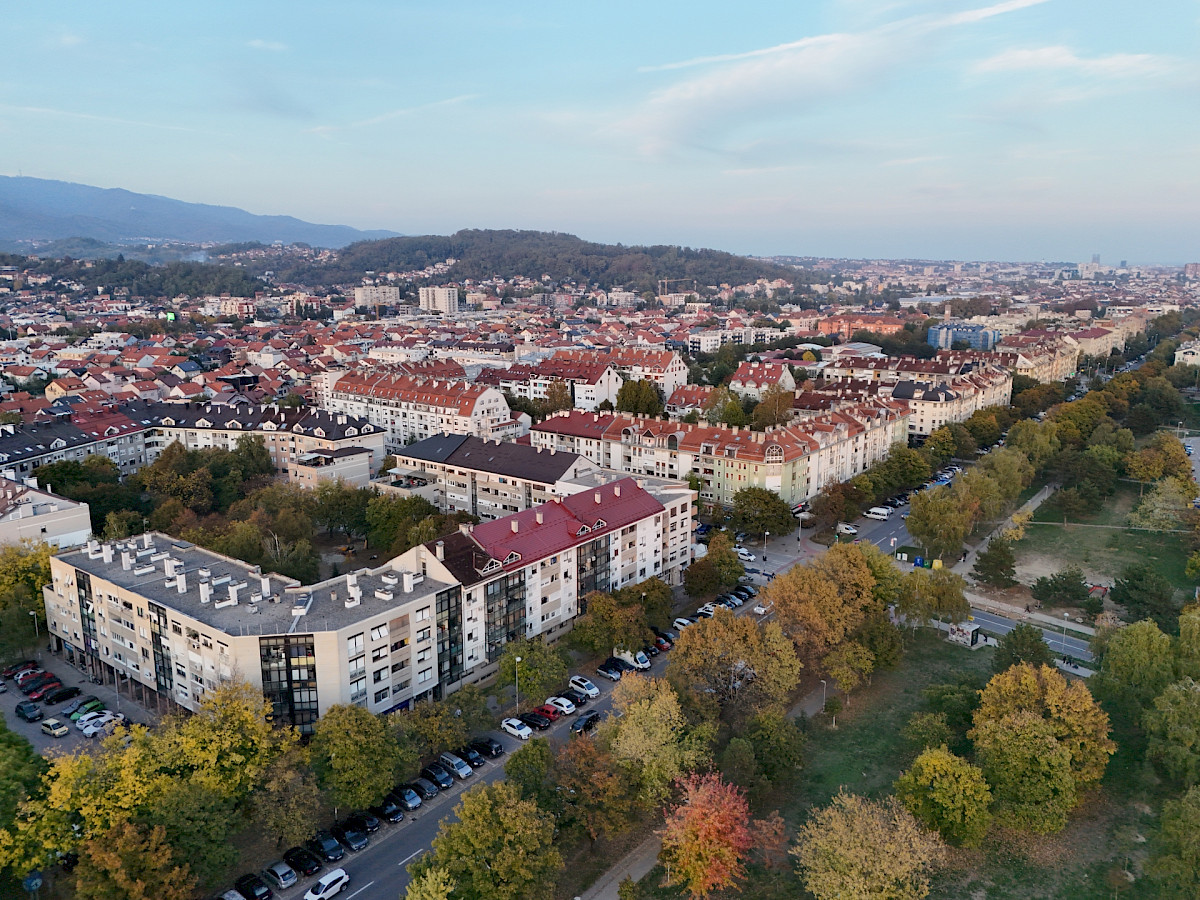
For years, real estate in the western part of Zagreb has been among the most sought-after on the market. If there is a neighborhood that perfectly balances urban functionality, a quiet family life, and a pleasant atmosphere, it is undoubtedly Malešnica. Often described as a "neighborhood tailored to people," Malešnica is one of the few residential areas where thoughtful urban planning is evident at every turn.
In this blog, we provide a detailed overview of the history, urban design, statistical indicators, and real estate market conditions of this beloved western Zagreb neighborhood.
History and Urban Development: The Last Planned Neighborhood
Although the Stenjevec city district—to which Malešnica administratively belongs—has a rich history dating back to antiquity and the era of the Roman Empire, the neighborhood of Malešnica itself acquired its current, recognizable form toward the end of the 20th century.
The initial urban plan for the Malešnica area was drafted in 1976. It established the axes for what are now the main streets: Ivana Brlić-Mažuranić Street (formerly Moskovska Street) and Ante Topić Mimara Street (formerly Mramoračka Street). A key turning point occurred with the adoption of the 1987 Stenjevec–Malešnica Implementation Urban Plan (PUP), authored by architects Ratko Miličević and Damir Rubeša. The authors' task was to rationalize the original concept, enabling the construction of approximately 3,200 housing units—an increase from the initially planned 2,600—while maintaining the existing traffic network. The result is remarkable: Malešnica stands as the last major planned residential neighborhood in Zagreb developed during the era of the former Yugoslavia.
Unlike older neighborhoods characterized by vast concrete plazas, Malešnica was conceived as a reinterpretation of the classic "Lower Town" (Donji grad) urban block. Elongated pedestrian courtyards, internal parks, squares, and green corridors are woven into a cohesive whole, designed with the needs of its residents in mind. The neighborhood’s distinct visual identity is defined by the diverse facades of its buildings; as a dozen different construction firms and architects participated in its development, each corner bears a unique architectural signature.
Key landmarks within the neighborhood include the linear park along Ivana Brlić-Mažuranić Street, the triangular Square of the Croatian Paulines (also known as the "Green Cathedral"), and the architecturally striking Lucijan Vranjanin Gymnasium—a work by the prominent architect Andrija Mutnjaković.
Statistical Data and Geographical Location
Administratively, Malešnica is part of the Stenjevec City District, which has a total population of approximately 51,000 and stretches from Zagrebačka Avenue in the south to Aleja Bologne in the north. The Malešnica Local Committee itself encompasses a densely yet pleasantly settled area, home to about 12,000 residents.
Neighboring Neighborhoods and Transport Connections
Malešnica enjoys an excellent location in the western part of the city, bordering several popular neighborhoods:
• Špansko – located directly along the southern and southwestern edge.
• Stenjevec – situated to the west and northwest.
• Vrapče – located to the east and northeast of the neighborhood.
• Oranice – found in the southeastern vicinity.
Transport connectivity in Malešnica is outstanding. It is located near Zagrebačka Avenue, allowing for a quick exit from the city toward the motorway, as well as easy access to the Jankomir commercial zone. Public transport options include numerous bus lines, while a suburban railway station to the north provides a connection to the very center of Zagreb in just about fifteen minutes.
Why We Love Malešnica: Infrastructure and Quality of Life
Daily life in Malešnica is organized so that everything is within walking distance:
1. Education and Childcare: Malešnica Elementary School and the Lucijan Vranjanin Gymnasium form the educational backbone of the neighborhood, complemented by several kindergartens.
2. Green Spaces and Recreation: Spacious parks are equipped with children’s playgrounds, benches, and walking paths. Tree-lined avenues provide natural shade during the summer months.
3. Everyday Amenities: The neighborhood features pharmacies, healthcare facilities, a post office, shops, and pleasant local cafés. With its quiet residential streets and abundance of green spaces, Malešnica is a prime choice for family life.
The Real Estate Market in Malešnica
The real estate market in Malešnica is characterized by high demand and price stability. The housing stock consists of high-quality, mid-rise buildings, featuring underground garages and well-landscaped surroundings.
The average price per square meter in Malešnica is higher than in the neighboring Špansko; this is due to a newer housing stock, thoughtful urban planning, and the well-maintained, organized nature of the neighborhood.
If you are considering selling or exchanging your property, a free property valuation is the first and most important step toward determining its realistic market value and achieving the best possible price.
When selecting an agency to manage the entire buying or selling process, it is crucial to choose licensed professionals with in-depth knowledge of the western part of Zagreb. The agency RESIDENT Nekretnine stands out for its professional approach, legal security, and top-tier real estate brokerage services.
Conclusion
Malešnica demonstrates how high-quality urban planning creates the perfect conditions for modern living. With its parks, comprehensive infrastructure, excellent transport connectivity, and a stable real estate market, Malešnica rightfully earns the title of a neighborhood designed with people in mind.