

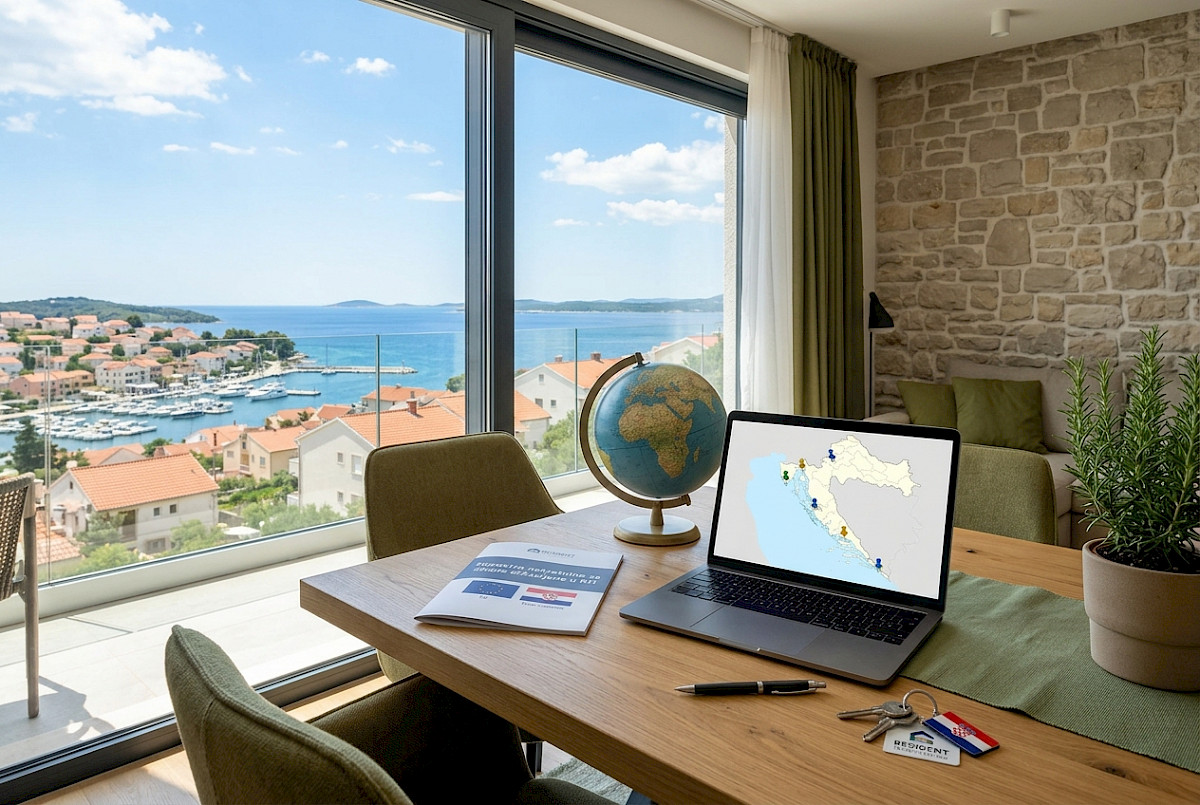
For many years, Croatia has attracted numerous foreign investors, admirers of the Adriatic, and retirees seeking an oasis of peace along our coast or in the continental interior. Whether it is a holiday home, a luxury villa, or an apartment in Zagreb, interest in real estate remains strong. However, the purchasing process differs depending on whether the buyer comes from the European Union or from a third country.
Below, we provide a comprehensive guide covering the legal requirements, necessary documentation, and key steps you need to know before becoming a property owner in Croatia.
1. Purchasing Real Estate: Citizens of the European Union (EU/EEA)
Thanks to Croatia’s membership in the European Union, citizens of EU member states—as well as nationals of countries within the European Economic Area (EEA)—now enjoy essentially the same rights to acquire real estate as Croatian citizens.
Key benefits and rules for EU citizens:
• Freedom to purchase: EU citizens are free to purchase apartments, houses, commercial premises, and building land without requiring special authorization from the Ministry of Justice, Public Administration, and Digital Transformation.
• Exceptions (agricultural and forest land): Under the Accession Treaty and subsequent extensions, certain restrictions remain in place regarding the acquisition of agricultural land and forests. However, for the majority of buyers seeking residential property, these obstacles do not pose an issue.
• Land registry enrollment process: Once the purchase agreement has been concluded and certified by a public notary, the registration of ownership rights with the court proceeds in the same manner as it does for domestic buyers.
2. Purchase of Real Estate by Citizens of Third Countries (Outside the EU/EEA)
For citizens of countries that are not members of the EU or the EEA (such as the United Kingdom, the United States, Bosnia and Herzegovina, Serbia, etc.), the rules are significantly more complex and subject to stricter legal scrutiny.
Key requirements for buyers from third countries:
• Principle of reciprocity: Foreign nationals may acquire ownership rights to real estate in Croatia only if there is reciprocity between the Republic of Croatia and their home country. This means that citizens of that country must have the legal right to purchase real estate in that foreign country under the same conditions that Croatia offers to their citizens. A list of countries with established reciprocity is maintained by the Ministry of Justice, Public Administration and Digital Transformation.
• Consent from the Ministry of Justice: Citizens of third countries are required to obtain approval (consent) from the Ministry of Justice in order to purchase real estate. Without this consent, the buyer cannot be registered as the owner in the land registry.
• Restrictions: Foreign nationals from third countries cannot acquire ownership rights over agricultural land, forests, or real estate located within protected natural areas of special significance, unless otherwise stipulated by a specific law.
Important note: The process of obtaining consent from the Ministry of Justice can take several months; therefore, it is advisable to include a clause in the purchase agreement stipulating that the payment of the purchase price and the transfer of ownership are contingent upon obtaining said approval.
3. Documentation required for a successful purchase
Whether you are from the EU or a third country, verifying the legal status of the property is the foundation of any secure transaction. Before signing a contract, be sure to check the following:
1. Land Registry Extract (*izvadak iz zemljišnih knjiga*): Confirms clear ownership and the existence of any encumbrances (such as mortgages or legal notations).
2. Cadastral Record (*posjedovni list*): Ensuring that the data in the cadastre matches the land registry records is crucial for a smooth transfer of ownership.
3. Occupancy Permit (*uporabna dozvola*): A document confirming that the structure was built in accordance with the building permit (essential for obtaining a mortgage loan or insurance).
4. OIB (Personal Identification Number): All foreign nationals purchasing real estate in the Republic of Croatia must first apply for and obtain a Croatian OIB through the competent Tax Administration office or a Croatian diplomatic or consular mission.
How can experts simplify the process for you?
The entire process—from finding the ideal property on the coast or inland, through legal checks and obtaining permits, to the final transfer of utility accounts—can be demanding, especially for foreign nationals unfamiliar with the local administrative system.
This is precisely why engaging a reliable agency is of invaluable importance. The agency RESIDENT Nekretnine stands out as a trusted expert in real estate brokerage, providing clients with comprehensive legal and logistical support at every step of the process. The experienced team at RESIDENT Nekretnine ensures that the purchase is secure, transparent, and stress-free, regardless of whether you are coming from an EU member state or a third country.
Conclusion
Purchasing real estate in Croatia is an excellent life and investment decision. While EU citizens benefit from a faster and simpler acquisition process, nationals of third countries must account for specific administrative steps, such as verifying reciprocity and obtaining consent from the Ministry of Justice. With timely...